General rule for all Backgamon games

Quote from Vasilis on May 18, 2019, 8:09 amThe most important rule in a backgammon game is that you have to move the checker(s) as many spaces as the sum of the dice (or four times the dice if you roll doubles) is equal to. If you can not make this move, then you need to move one chip as many spaces as the largest dice (or if you roll doubles, the largest multiplier of the dice) is equal to. This may sound easy to achieve, but it can be tricky.
Consider, for example, the case where you roll a 4 and a 3. Based on the above rule, you can either move one checker 7 spaces or one checker 4 spaces and another one 3 spaces. At the beginning of a game, you could easily follow this rule. But as the game progresses, and your opponent is blocking you, you may find yourself in the unfortunate situation to make a move that you do not want to. So, in our previous example, if all checkers could move 4 spaces, and there is only one checker that can move 4 and then 3 spaces, you have to move that checker. If you move any of the other checkers, you will violate this rule.
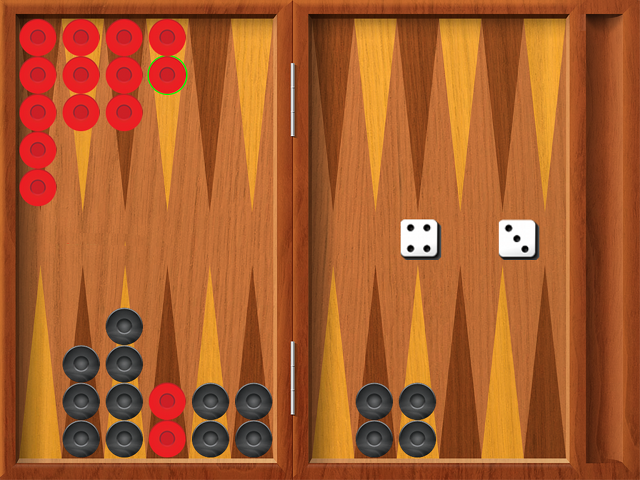
The iTavli game enforces this rule, as you can see in the screenshot. The player could move two checkers, but iTavli does not allow the player to move the selected checker. If the player had been able to move that checker, (s)he would not be able to play the first dice (i.e., 4). Thus, the player has to move one of the checkers that lie across the board from the selected checker.
The most important rule in a backgammon game is that you have to move the checker(s) as many spaces as the sum of the dice (or four times the dice if you roll doubles) is equal to. If you can not make this move, then you need to move one chip as many spaces as the largest dice (or if you roll doubles, the largest multiplier of the dice) is equal to. This may sound easy to achieve, but it can be tricky.
Consider, for example, the case where you roll a 4 and a 3. Based on the above rule, you can either move one checker 7 spaces or one checker 4 spaces and another one 3 spaces. At the beginning of a game, you could easily follow this rule. But as the game progresses, and your opponent is blocking you, you may find yourself in the unfortunate situation to make a move that you do not want to. So, in our previous example, if all checkers could move 4 spaces, and there is only one checker that can move 4 and then 3 spaces, you have to move that checker. If you move any of the other checkers, you will violate this rule.
The iTavli game enforces this rule, as you can see in the screenshot. The player could move two checkers, but iTavli does not allow the player to move the selected checker. If the player had been able to move that checker, (s)he would not be able to play the first dice (i.e., 4). Thus, the player has to move one of the checkers that lie across the board from the selected checker.
Uploaded files: